|
by Samir Salifou
Income inequality in America has reached levels of national embarrassment. If a government’s actions should reflect society’s desires, then somewhere along the way the American democratic process has gone awry. According to a Harvard Business School study, 90 percent of Americans believe that the income gap is too wide. There is a national consensus around fixing income inequality, and the solution isn’t difficult. First, we must raise the minimum wage and stop subsidizing low-cost jobs. Second, we must make access to a higher education affordable and attractive to youth. The numbers are staggering. In a study conducted by Harvard Business School Prof. Michael Norton, more than 90 percent of Americans believe that the top quintile of society should hold 33 percent of the national wealth and that the bottom 40 percent should hold 25 percent of the national wealth. The real numbers are far different. The top quintile holds more than 80 percent of the national wealth and the bottom two quintiles hold sequentially 0.3 percent of the national wealth. If 9 out of 10 Americans agree that the income gap should be narrower than it is, then this is not a partisan issue. It is an issue of national importance that needs to be addressed urgently.
1 Comment
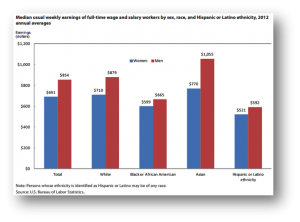 Median usual weekly earnings of full-time wage and salary workers by sex, race, and Hispanic or Latino ethnicity, 2012 annual averages from the Bureau of Labor Statistics in October 2013.In 1911, the political philosopher Hurbert Croley wrote, “a democracy, not less than a monarchy or an aristocracy, must recognise [sic] political, economic, and social distinctions, but it must also withdraw its consent whenever these discriminations show any tendency to excessive endurance.The gender-based pay gap is one such distinction that needs to be revisited. However, education, career choice, and hours worked contribute most to this pay gap, meaning those factors – rather than discrimination – deserve our attention. Median usual weekly earnings of full-time wage and salary workers by sex, race, and Hispanic or Latino ethnicity, 2012 annual averages from the Bureau of Labor Statistics in October 2013.In 1911, the political philosopher Hurbert Croley wrote, “a democracy, not less than a monarchy or an aristocracy, must recognise [sic] political, economic, and social distinctions, but it must also withdraw its consent whenever these discriminations show any tendency to excessive endurance.The gender-based pay gap is one such distinction that needs to be revisited. However, education, career choice, and hours worked contribute most to this pay gap, meaning those factors – rather than discrimination – deserve our attention. by Samir Salifou
The notion that equality of opportunity undergirds political and economic success lies at the core of American meritocracy. Hard work and determination, as opposed to family background, should allow individuals to ascend the socioeconomic ladder. In 1965, when discussing race-based affirmative action, then-President Lyndon Johnson recognized this issue, sayingthe United States had an obligation to do more than undo inequitable laws. “You do not take a person who, for years, has been hobbled by chains and liberate him, bring him up to the starting line of a race and then say you are free to compete with all the others, and still just believe that you have been completely fair,” Johnson said. Title VII of the Civil Rights Act of 1964 already bans sex-based discrimination, and the 19th Amendment gave women the right to vote, but those changes did not address structural concerns. In 2009, President Barack Obama signed into law the Lilly Ledbetter FairPay Act. The law restored preexisting law, which helped guarantee that individuals subject to pay discrimination have up to 180 days from their last discriminatory paycheck to file a civil suit against their former employer. But this bill failed to address underlying structural issues. by Carter Blackwell
Medicaid expansion would cost Virginia $137.5 million dollars over the 2014-2022 period, with yearly costs rising as time progresses. Expansion would increase costs to Virginia and reduce incentives for private investment in health insurance. Refusal to expand the Medicaid program is in the best interest of the Commonwealth and provides the state with the most economic stability in the long run. More than one million Virginia residents currently receive Medicaid and our state legislature is responsible for 50 percent of the funding. The Commonwealth spends over three billion dollars per year on Medicaid, comprising 21 percent of our state’s annual budget. Expansion aside, Medicaid costs are steadily rising at nine percent per fiscal year as the number of program participants continues to increase. The Commonwealth of Virginia is one of many states currently undecided regarding the expansion of Medicaid through the Affordable Care Act. While Gov. McAuliffe supports the move, Republicans in the State House and Senate stand in vehement opposition. Acceptance or denial of ACA expansion will greatly affect those in need of healthcare as well as those in the private insurance and healthcare industries. |